
What Are Joro Spiders?
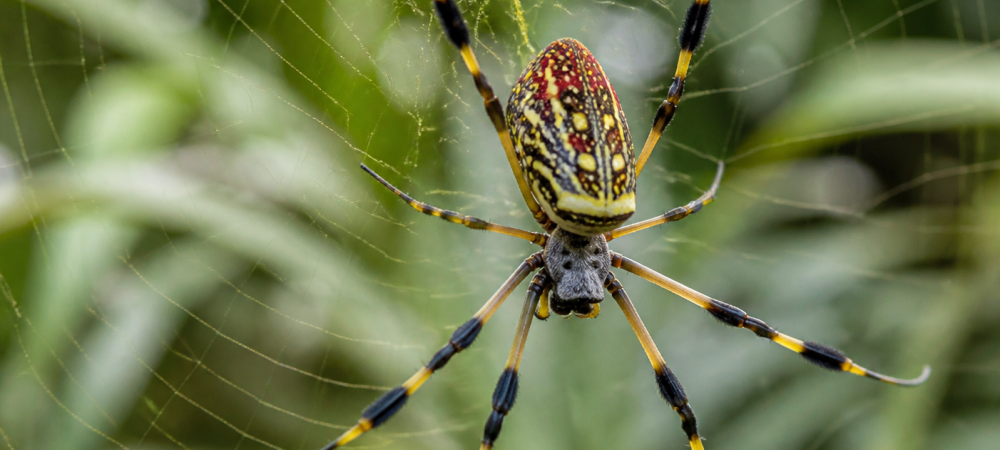
A Joro spider is a large orb-weaving spider native to East Asia that became established in the southeastern United States after it was found in Georgia in the mid-2010s. The spider people notice is the adult female, with a bright yellow abdomen marked by blue-gray bands, long black legs with yellow banding, and a leg span that can approach four inches. Joro spiders are harmless to people and pets, and they are among the most reluctant spiders to bite.
What Does a Joro Spider Look Like?
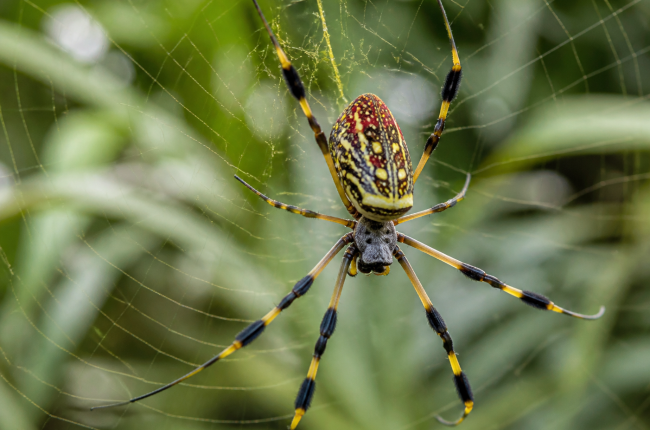
An adult female Joro spider has a body up to about an inch long with a leg span approaching four inches, which is what makes the first sighting so memorable. The abdomen is bright yellow with gray-blue banding across the top, and the underside carries an intricate yellow and gray-blue pattern with a large red marking. The legs are black with distinct yellow bands.
Male Joro spiders look like a different species entirely. Males are narrow, brown, and less than a quarter the size of a female, and they usually sit near the edge of a female's web rather than building their own.
The coloring is most vivid from late summer into fall, which is also when the females reach full size. That timing is why so many people notice Joro spiders all at once in September and October and assume the population exploded overnight.
Are Joro Spiders Dangerous?
Joro spiders are not dangerous to people, pets, or livestock. Like nearly all spiders they are technically venomous, but the venom is weak from a human health standpoint and is built for subduing insects.
Research has tested this directly. When researchers handled Joro spiders, touched their webs, poked them, and squeezed them, the spiders overwhelmingly chose to freeze or flee rather than bite. Joro spiders also stay frozen far longer than other spiders after being disturbed, sometimes for more than an hour, which is the opposite of aggressive behavior.
A brown recluse or a black widow, both far smaller and far less conspicuous, presents a genuinely greater concern than a Joro spider does.
Do Joro Spiders Bite?
Joro spiders can bite, but bites are rare and require real provocation. Their fangs are small and often cannot reliably break human skin.
In the uncommon cases where a bite does happen, the result is minor. Reported effects are localized pain and redness that resolve quickly, described as less painful than a bee sting and comparable to a mosquito bite. As with any insect or spider, a small number of people may have an allergic reaction, so a bite that produces symptoms beyond local irritation is worth a call to a doctor.
Can Joro Spiders Fly?
Joro spiders cannot fly. The widely repeated claim about flying spiders comes from a misreading of how young spiders disperse.
Worth knowing: Joro spiderlings travel by ballooning, which means releasing a strand of silk that catches the wind and carries the spiderling on air currents. Ballooning is passive drifting, not flight. The spiderling has no control over direction or distance, and it is a behavior many spider species use. Adult Joro spiders do not balloon at all. They are too heavy. So the image of a four-inch spider soaring over a neighborhood is not something that happens, and it never did.
They're great hitchhikers as well. Egg sacs and spiders ride along in vehicles, on cargo, in landscaping material, and on anything else that moves between regions.
Where Are Joro Spiders Found?
In the southeastern United States, joro spiders are found in Georgia, Mississippi, Ohio, Maryland, South Carolina, North Carolina, Tennessee, Alabama, Kentucky, Virginia, and West Virginia. Isolated sightings have been reported well outside that core range, though a single sighting does not mean a breeding population has taken hold in that area.
The range is expected to keep expanding. Joro spiders tolerate cooler conditions than many people assume, they do well in developed areas rather than avoiding them, and the hitchhiking habit moves them faster than they could ever spread on their own.
Why Is the Web So Big?
A Joro spider builds a large golden orb web because that is how orb-weavers of its size hunt. The web can stretch several feet across and is often anchored between trees, along eaves, across porch railings, or between a house and a shrub.
The silk has a distinctly golden cast that catches direct sunlight, which is where the golden orb-weaver name comes from. The web is also strong enough that walking into one is genuinely startling, and that experience is the single most common complaint about this spider.
How Do You Get Rid of Joro Spiders?
Knocking down the web with a broom or a stick and relocating the spider handles the problem in most cases. The spider may rebuild in the same spot, so expect to repeat it a few times before it moves on.
Broad pesticide spraying is a poor fit for this particular problem. Spraying outdoors to target one large, visible, harmless spider also kills native spiders, pollinators, and other beneficial insects, and it does nothing to stop new Joro spiders from drifting or hitchhiking in later. Removing webs from the areas you actually use, such as doorways, porches, and walkways, is both more effective and more proportionate.
Reducing what draws them helps more than treating the spiders directly. Exterior lights pull in the flying insects that Joro spiders build near, so switching to yellow bulbs or motion-activated fixtures reduces the food supply around entryways.
Key Takeaways
- A Joro spider is a large orb-weaving spider native to East Asia, established in the southeastern United States since the mid-2010s.
- Adult female Joro spiders are bright yellow with blue-gray bands and a leg span approaching four inches. Males are small and brown.
- Joro spiders are harmless to people and pets, and their venom is not medically significant.
- Joro spiders rarely bite, and testing shows they freeze or flee rather than defend themselves.
- Joro spiders cannot fly. Young spiders balloon on wind currents, and adults are too heavy to do even that.
- Joro spiders spread mainly by hitchhiking on vehicles and cargo.
- Knocking down webs is more effective and more proportionate than spraying pesticides outdoors.
- Adult Joro spiders die off in winter, and egg sacs carry the population into spring.
Seeing More Spiders Than You Used To?
A single large spider on the porch is usually a knock-the-web-down situation rather than a pest control problem. Steady spider activity inside the house is a different signal, because spiders follow their food, and a consistent indoor spider population usually means there is a steady insect population feeding it. If that is what you are seeing, American Termapest, Inc. can inspect the home, identify what is drawing them in, and put together a pest control plan that addresses the source. Request a free quote to get started.