

We locate active nests and apply targeted treatments to reduce activity and limit the risk of repeat nesting around your home.
Stinging Control in Five Forks, SC
Stinging insects have a way of taking over outdoor spaces fast, and when carpenter bees, wasps, yellowjackets, or hornets move in around your home, it becomes harder to use the spaces you've worked for. The good news is this is a solvable problem, and you don't have to wait it out or deal with it on your own.
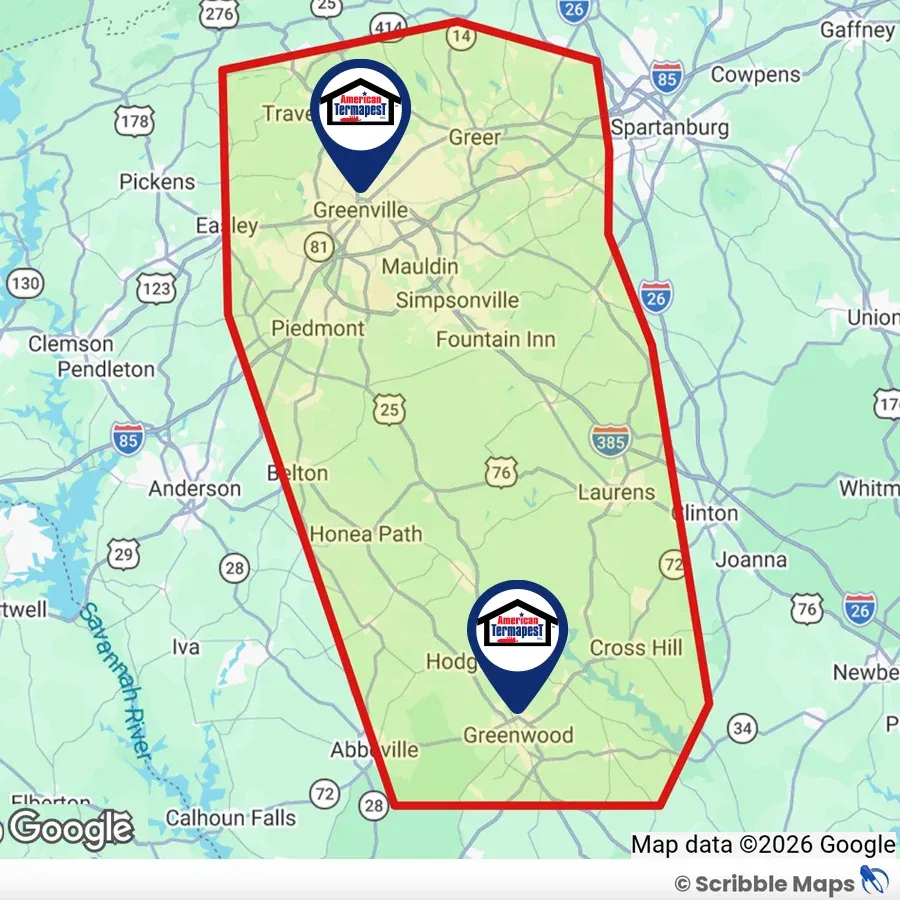
American Termapest has been handling stinging insect problems for 71 years across Five Forks and the surrounding communities. The process is straightforward: we identify where these insects are nesting or foraging, treat the source directly, and follow up to make sure the problem is actually resolved, not just temporarily disrupted.
Here's why homeowners in Five Forks keep calling us back:
- Locally owned, not a national chain
- Experienced with carpenter bees, wasps, yellowjackets, and hornets
- Treatment focused on the source, not just the surface
- Residential and commercial service available
- Reliable follow-through on every job
If stinging insects are making it hard to enjoy your yard or keep your property maintained, we're ready to help you get that back.
Additional Services in Five Forks
Stinging Insect Control for Carpenter Bees, Wasps, Hornets, and Yellowjackets
Stinging insects are not just a nuisance. Carpenter bees tunnel into wood trim, fascia, and decking, leaving real structural damage behind. Yellowjackets and hornets build nests near entryways, under eaves, and in the ground, and they get more aggressive as summer moves into fall. Paper wasps set up along rooflines and porches where people walk every day. When stinging insects take over a part of your property, the space stops being usable.
Homeowners in Five Forks deal with peak stinging insect pressure from early summer through fall, and waiting usually makes the problem worse.
- Targeted nest removal and treatment for paper wasps, yellowjackets, hornets, and carpenter bees
- Carpenter bee treatment that addresses active tunneling damage, not just the surface
- Nest identification and location assessment, including ground nests that are easy to miss
- Treatment timed to when colonies are most active, which improves results significantly
- Follow-up evaluation available to confirm nest activity has stopped before the season ends
American Termapest does not provide honey bee removal, but we can point you toward a local beekeeper if that is what you are dealing with. For carpenter bees, wasps, yellowjackets, and hornets, reach out today and get a straight answer on what it will take to handle the problem.
71 Years of Solving Pest Problems the Right Way
With 71 years of fieldwork behind us, we have seen every infestation imaginable and know exactly how to handle them fast.
That depth of experience means we identify the problem quickly, get it right the first time, and deliver the kind of reliable service that only comes from decades of doing this work day in and day out.
Stinging Insect Control in Five Forks
If you have noticed wasps building nests around your eaves, yellowjackets coming and going from a hole in the ground, or hornets hanging a paper nest from a tree branch, you already know how fast a stinging insect problem can get out of hand. In Five Forks, summer and early fall are when these insects are at their most active and their most aggressive.
Stinging insects send more than 500,000 people to emergency rooms in the United States each year. That number is not just about severe allergic reactions. Multiple stings from a disturbed colony are painful and dangerous for anyone. Yellowjackets in particular become increasingly defensive as summer wears on, and a nest in a wall void or under a deck can be nearly impossible to spot until you have already gotten too close.
What American Termapest Treats in South Carolina
The most common stinging insects on properties in this area include:
- Paper wasps nesting under eaves, porch ceilings, and window frames
- Yellowjackets nesting in the ground, wall voids, or structural cavities
- Hornets building aerial nests in trees, shrubs, or on structures
- Carpenter bees boring into wood trim, decks, and siding
Honey bee removal is not a service offered here. Active honey bee colonies are referred to local beekeepers who can relocate them safely.
Why Treatment Matters Beyond the Sting
Carpenter bees are easy to overlook because they do not sting aggressively, but the damage they leave behind adds up. They bore into unfinished or weathered wood, and the holes they create invite moisture and wood decay over time. Treating carpenter bee activity early protects your wood structures from compounding damage season after season.
For wasps, yellowjackets, and hornets, location matters as much as species. A nest near a doorway, playground, or high-traffic area carries more risk than one tucked far from where people spend time. Proper identification and placement determine how the problem is addressed and how urgently it needs to be handled.
If you have more questions about what to expect or which species you might be dealing with, the answers to the most common ones are covered below.